
The Startup’s Guide to Scaling Without Adding Complex Software
This guide is for the founder or manager who realizes that “more software” is often the enemy of “more growth.” When a startup begins to scale, the instinct is to bolt on a new tool for every new problem—one for CRM, one for project management, one for goal tracking, and another for internal documentation. Before you know it, your team is spending a massive chunk of their day just moving data between windows. True scaling isn’t about adding complexity; it’s about simplifying your foundation so your team can focus on the product, not the plumbing.

The goal is to build a “lean stack” where the tools grow with you. You need a system that handles the chaotic early days of five people in a garage just as well as a global team of five hundred. This means moving away from fragmented, specialized apps and toward unified project management tools where communication and execution happen in the same breath.
Building a Dynamic Foundation in Lark Base
For a scaling startup, spreadsheets quickly become a bottleneck. They are static, prone to version errors, and impossible to automate. Lark Base replaces the “chaos of the spreadsheet” with a flexible, no-code database that serves as your company’s operational engine. Whether you are tracking your first hundred customers, managing a content calendar, or building an inventory system, Base allows you to visualize that data in a way that makes sense for your current stage.
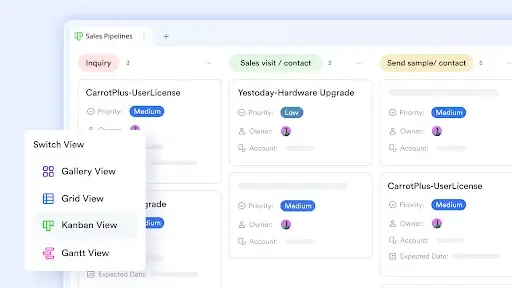
This is where you see the real departure from the limitations of project management tools that only offer one way to look at a task. In Base, you can flip from a Gantt chart to a Kanban board or a Gallery view with one click. Because it’s natively connected to your Messenger, you can set up automations that notify a channel the moment a lead moves to “Closed.” You are building a system that works for you, rather than hiring someone just to manage the data.
Strategic alignment through Lark OKR
As you grow from five people to fifty, the biggest risk is “mission drift.” Without a clear way to track goals, individual teams start pulling in different directions, wasting precious capital on low-impact projects. Lark OKR ensures that every person in the startup knows exactly what the “North Star” is. Unlike traditional goal-tracking software that lives in a forgotten tab, these OKRs are woven into the workspace.
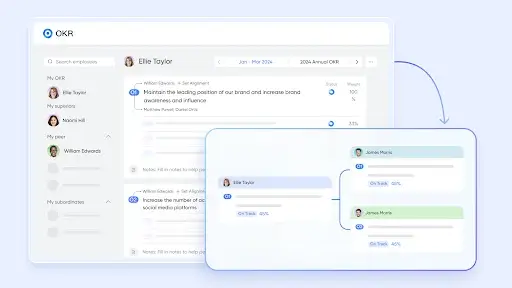
In Lark, your objectives are visible right next to your chat and your docs. When a developer looks at their task list, they can see exactly which high-level objective that task is supporting. It creates a culture of purpose and accountability that is essential for a high-growth environment. It ensures that as you scale, you are scaling your impact, not just your headcount.
Reducing administrative friction with Lark Approval
Bureaucracy is a startup killer. In the early days, you can approve a spend by shouting across the room, but as you scale, that “system” breaks. Without a formal process, you’re left with a chaotic mess of pings and emails that can delay offer letters or contract sign-offs for days.

This is a critical part of productivity tools for startups because it preserves your most valuable resource: momentum. A manager can review a request and hit “Approve” while waiting for a flight, ensuring the team isn’t standing still. By automating the “boring” parts of business management, you allow your leadership to stay focused on strategy and growth. You are building a professional infrastructure that feels as fast and fluid as a small team.
Preserving institutional intelligence in Lark Wiki
The fastest way to slow down a scaling startup is to force every new hire to “shadow” an old employee for three weeks just to learn the ropes. This is a massive drain on your best talent. Lark Wiki allows you to build a self-service onboarding machine. It’s a centralized home for your brand guidelines, technical specs, and cultural values.
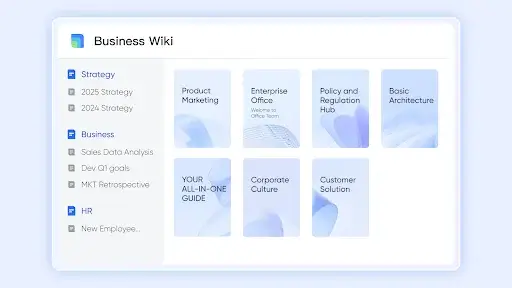
As you grow, the Wiki becomes your “shared brain.” It ensures that as people join and leave, the knowledge stays with the company. When information is searchable and structured, you eliminate the repetitive “How do I do X?” questions that interrupt your lead engineers and designers. You are creating a scalable culture where the answer is always just a search away. It’s about making sure your company gets smarter as it gets bigger.
Capturing every decision with Lark Tasks
Finally, scaling requires a move from “verbal agreements” to “documented execution.” Lark Tasks allows you to turn any conversation into a trackable item with a clear owner and deadline, ensuring that the great ideas from your brainstorming sessions actually get built. This simple habit prevents critical action items from getting buried in the scroll of a busy chat room.
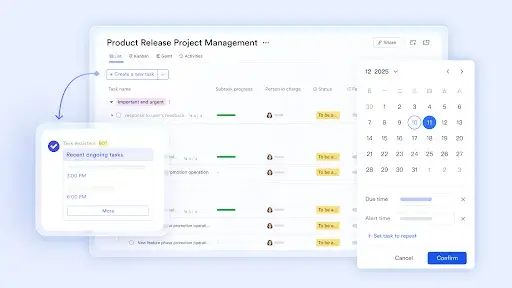
By keeping your task management within the same platform as your communication, you remove the friction of jumping between apps. A founder can assign a task during a quick sync and immediately see it added to the team’s shared list. This transparency ensures that nothing falls through the cracks during the rapid expansion of the business. It provides a clear roadmap of daily execution that keeps everyone aligned and moving forward.
Bonus: The “Shadow IT” trap: Why your app stack is a data risk
Most startups begin with Google Workspace pricing because it’s the standard for email. But because it lacks a high-speed chat or a real database, your team will naturally fill those gaps themselves. One person starts a WhatsApp group for urgent fixes; another tracks their specific pipeline on a private Trello board; a third saves meeting recordings to their personal Dropbox.
This creates “Shadow IT.” You are still paying for Slack or Asana for the company, but your most important conversations and data are actually living in personal accounts you don’t control. If an employee leaves, that institutional knowledge walks out the door with them. Lark solves this by providing a “Total Hub.” By giving your team a world-class messenger, database, and wiki in one place, you ensure that every byte of company data stays inside the company walls. You aren’t just saving on subscriptions; you are securing your company’s intellectual property.
Conclusion
Ultimately, scaling a startup is a test of how much “noise” your team can filter out. You don’t win by having the longest list of subscriptions; you win by having the shortest distance between an idea and its execution. By choosing a unified path and adopting a modern set of productivity tools, you are protecting your team’s most precious assets: their time and their focus.
You are building a company that isn’t just bigger, but faster and more resilient. The future of your business shouldn’t be buried in a dozen different tabs. It should be right there in front of you, in a single, synchronized flow that lets your people do what they do best—innovate. You can visit influencers gone wild for more trending posts.